.JPG)
Archives and Collections
Step into the rich tapestry of history with Shrewsbury School
A trove of stories, artefacts, and knowledge spanning centuries, our archives offer a fascinating glimpse into the past, enriching the present and inspiring the future.
We welcome visiting researchers; to arrange a visit, please contact our Archivist and Head of Special Collections, Naomi Nicholas, at [email protected].
Meet the Head of Special Collections
Naomi took over as Head of Special Collections at Shrewsbury School in January 2025 after working for the last ten years alongside Robin Brooke-Smith as Assistant Archivist & Rare Book Librarian, helping to develop the school’s archive and rare book collection.
“I can honestly say my work brings me joy daily, and it is an honour to be caring for the wonderful collections held by Shrewsbury School. I love delving into our forgotten treasures and curating exciting new exhibitions and supporting fellow researchers and visitors.".
Charles Darwin Exhibition
Select an image .JPG)
A timeline of Charles Darwin's Letters
From Shrewsbury School to one of the most influential naturalists in history.
Born in Shrewsbury on the 12th of February 1809, the Old Salopian's ground-breaking work continues to shape our understanding of life on Earth, inspiring generations of scientists and thinkers. His legacy continues to inspire Salopians to explore, question and push knowledge boundaries.
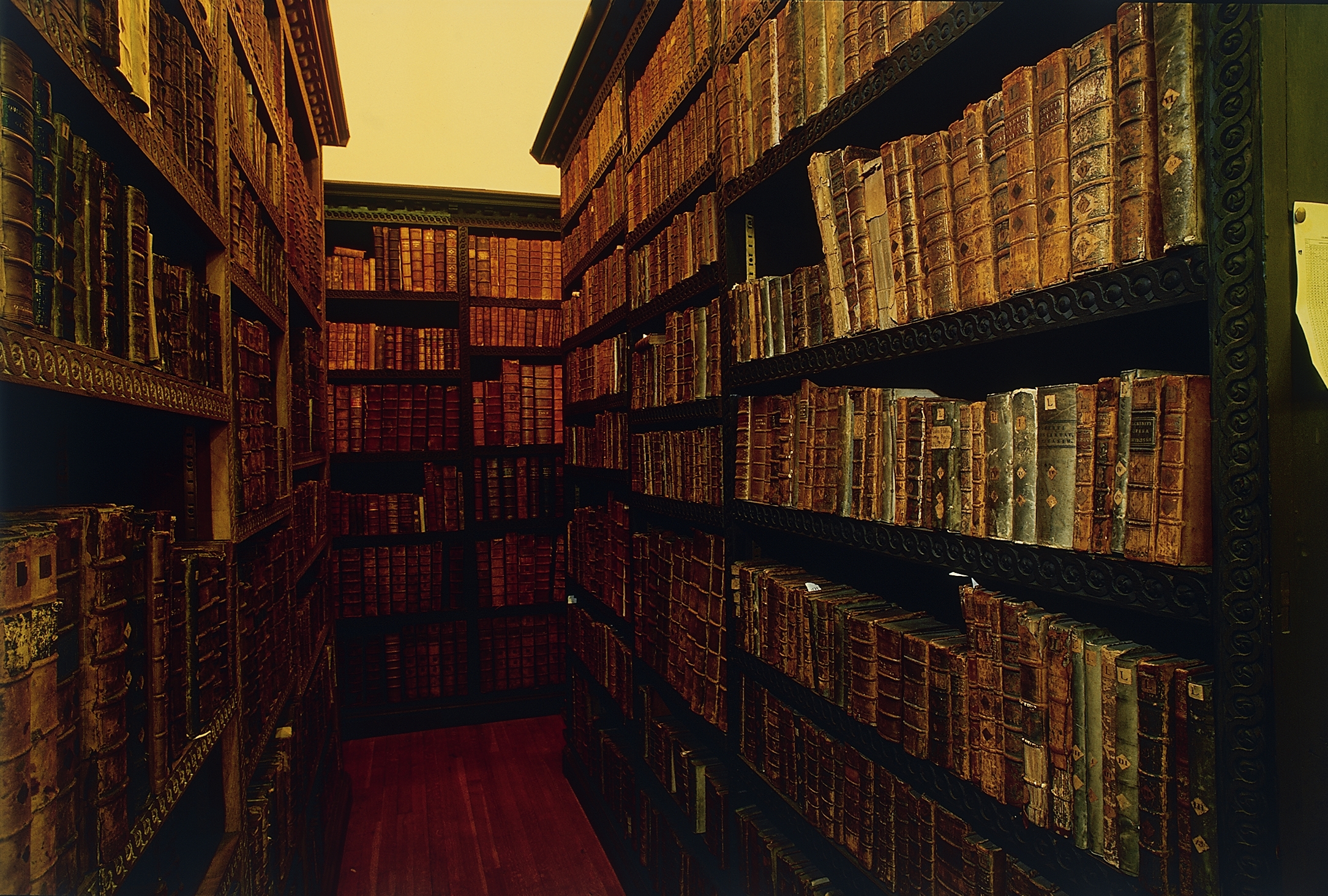
The Ancient ('Taylor') Library
The Ancient Library of Shrewsbury School was founded in 1606 by the Headmaster John Meighen, in part fulfilment of the development plan laid down in Thomas Ashton's Ordinances of 1578. It was housed in a a purpose designed building built in 1595, in a room fitted out with presses and chained like a contemporary Oxford or Cambridge college library. Above it was a walking gallery intended for mathematical and astronomical instruments.
The first acquisition was in 1596, a terrestrial globe by the first English globe maker Emery Molineux. The library grew quickly by gift, bequest and purchase, and the stock was always intended to include all learning, not merely the limited grammar school syllabus. It was thematically catalogued from the outset and its growth can be gauged from accession rolls, donor's book and successive catalogues. The chains were removed in 1737 when it became a borrowing library.
Before 1640 the school acquired some forty medieval manuscripts, most of which survive, including a fine twelfth-century Gradual from Haughmond Abbey and the Lichfield Processional with its unique liturgical English plays of circa 1430 and polyphonic music. Particular treasures are a fine collection of bookbindings ranging from the twelfth-century to the present day, some sixty books printed before 1500 including John Gower's 'Confessio Amantis' printed by Caxton in 1483, and a representative collection of seventeenth-century scientific, medical and natural history books, mostly drawn from the libraries of two Shrewsbury doctors and bequeathed in 1688 and 1712. The school bought Newton's 'Principia' on publication in 1687.
In 1766 the Revd. Dr. John Taylor, ex Cambridge don, Old Salopian and eminent Greek scholar, bequeathed his library of some 3,500 books to the school, more than doubling the size of the library. His collection is particularly rich in works relating to Roman antiquities in Italy, Greek authors and English antiquarianism. His manuscripts were bequeathed elsewhere, with the exception of a remarkable Elizabethan town chronicle for Shrewsbury known as 'Dr. Taylor's MS'. His collection has always been kept as an entity, and since 1966 has given its name to the whole Ancient Library.
The library also includes books, manuscripts and letters of Charles Darwin and Samuel Butler.
Select an image